Parisian apartment kitchens
7 October 2020 03:01 am![[personal profile]](https://www.dreamwidth.org/img/silk/identity/user.png) igenlode
igenlodeSo I didn't watch the film, because I disappeared down a rabbit-hole of research while trying to write a quick review on someone else's story. (Most of which I didn't eventually put into the review, because this is stuff I didn't actually know beforehand but just had enough suspicion of to guess that the author's assumptions were anachronistic...)
https://victorianparis.wordpress.com/2013/04/18/living-vertically-parisian-housing-in-1850-part-1/
Haussmann-style apartments are constructed around courtyards, two to each floor of the building, "the one facing the street, the other the courtyard" (I can't visualise how that works with a square -- or does that imply a street on each side of the square?)
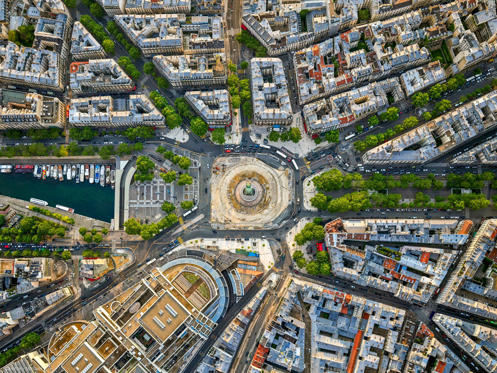
and the 'connecting arms' being the kitchen and 'other conveniences'. There are two staircases, one for the use of the tenants, and the other, "l'escalier de service", for servants only.
The ground floor is occupied by "shops, stables" and the concierge. The internal courtyard is "of sufficient size for a carriage to turn" and is accessed by a large porte-cochère. The first floor is known as the 'entresol' and is relatively cheap to rent because it is overshadowed by the towering buildings opposite. In Paris the entresol exists because the height necessary for the porte-cochère exceeded that of the rooms of the ground floor: https://fr.wikipedia.org/wiki/Entresol
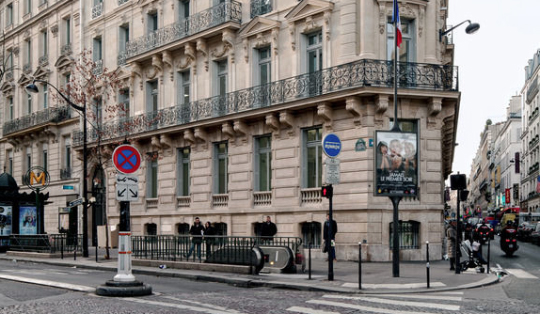
The most expensive apartments are on the floor above this and decrease all the way up to the servants' rooms in the attic, "two or more of these rooms belonging to each apartment".
The apartments are usually let out fully furnished with the exception of linen and silver, which are hired separately (apparently not including table-cloths; bed-linen?) https://victorianparis.wordpress.com/2013/05/07/living-vertically-parisian-housing-in-1850-part-2/
The kitchens were small, dark and hidden away down a long corridor for ease of access from the back staircase, which also led up to the 'chambres de bonnes' in the attic; they were the servants' domain into which the masters were not expected to penetrate. "The kitchen was the place no-one should see". https://cloisteredaway.com/kitchen-cecile-molinie/
https://www.pariszigzag.fr/secret/histoire-insolite-paris/reconnaitre-immeuble-haussmannien
The servants' floor had communal bathrooms.
http://magenealogie.eklablog.com/la-domesticite-au-19e-et-debut-du-20eme-siecle-2-a127088180
Zola describes l'immeuble hausmannien in "Pot-Bouille": https://www.lesdecouvreurs.com/immeuble-haussmannien-architecture-paris/
Paris roads and traffic: http://attelages-magazine.com/articles/tradition/les-embarras-de-paris.html

https://victorianparis.wordpress.com/2013/04/18/living-vertically-parisian-housing-in-1850-part-1/
Haussmann-style apartments are constructed around courtyards, two to each floor of the building, "the one facing the street, the other the courtyard" (I can't visualise how that works with a square -- or does that imply a street on each side of the square?)
and the 'connecting arms' being the kitchen and 'other conveniences'. There are two staircases, one for the use of the tenants, and the other, "l'escalier de service", for servants only.
The ground floor is occupied by "shops, stables" and the concierge. The internal courtyard is "of sufficient size for a carriage to turn" and is accessed by a large porte-cochère. The first floor is known as the 'entresol' and is relatively cheap to rent because it is overshadowed by the towering buildings opposite. In Paris the entresol exists because the height necessary for the porte-cochère exceeded that of the rooms of the ground floor: https://fr.wikipedia.org/wiki/Entresol
The most expensive apartments are on the floor above this and decrease all the way up to the servants' rooms in the attic, "two or more of these rooms belonging to each apartment".
The apartments are usually let out fully furnished with the exception of linen and silver, which are hired separately (apparently not including table-cloths; bed-linen?) https://victorianparis.wordpress.com/2013/05/07/living-vertically-parisian-housing-in-1850-part-2/
The kitchens were small, dark and hidden away down a long corridor for ease of access from the back staircase, which also led up to the 'chambres de bonnes' in the attic; they were the servants' domain into which the masters were not expected to penetrate. "The kitchen was the place no-one should see". https://cloisteredaway.com/kitchen-cecile-molinie/
https://www.pariszigzag.fr/secret/histoire-insolite-paris/reconnaitre-immeuble-haussmannien
The servants' floor had communal bathrooms.
Dans la cuisine, minuscule, la bonne fait bouillir sur la cuisinière la lessiveuse pendant des heures ; elle étend le linge, toujours dans la cuisine sur des cordes ; l’humidité, il va sans dire n’est pas évacuée et reste dans la pièce rendant l’air malsain ; le repassage se fait aussi dans la cuisine sur une planche de fortune à côté du dîner qui cuit. La cuisine pièce que l’on cache, que l’on remise au bout du logement.
http://magenealogie.eklablog.com/la-domesticite-au-19e-et-debut-du-20eme-siecle-2-a127088180
Les cuisines au 19ème siècle sont, on l’a vu, petites, encombrées, pas ou peu aérées.
La bonne doit y passer son existence sans pouvoir se retourner aisément, avec la chaleur du fourneau, les fumées, les odeurs qui la forcent à travailler fenêtre ouverte, été comme hiver.
La fenêtre donne souvent sur une cour, petite (souvent de l’ordre de 4/5m2) et sans soleil et où s’accumulent toutes les poussières de la maison que les domestiques y déposent en secouant les tapis et autres plumeaux. Le garde-manger est d’ailleurs le réceptacle des toutes ces poussières.
Le docteur Oscar du Mesnil dans un article intitulé « La question des courettes de Paris » dénonce l’insalubrité que crée dans la capitale ces courettes : « de véritables puits de 15 à 17m de profondeur ne communiquant avec l’extérieur que par leur orifice supérieur et dont les parois emprisonnent une colonne d’air infectée par les émanations fétides qui s’échappent nuit et jour des cabinets d’aisance et des cuisines… ».
N’oublions pas que souvent les bonnes dorment dans leur cuisine ; les médecins protestent contre ce mode de couchage : coucher dans une cuisine est dangereux « car un jour ou deux par semaine le linge de la lessive sèche et répand une telle humidité que les domestiques qui couchent là contractent immanquablement des rhumatismes ».
Un observateur en 1912, Marcel Cusenier, note à Paris que : « dans le quartier de Grenelle et de Javel de nombreuses cuisines n’ont même pas de fenêtres ; elles prennent le jour sur l’escalier où se répandent toutes les odeurs …. Parfois au-dessus du fourneau la hotte manque ; l’oxyde de carbone qui se dégage inévitablement de tout fourneau ne trouve pour ainsi dire plus d’issue : c’est l’intoxication lente et fatale.
Dans certaines cuisines passent des trémies d’aération pour les WC voisins. Ces trémies ont jusqu’à deux mètres de long. L’étanchéité n’est jamais parfaite. Quelles émanations viennent se mélanger à celles des cuisines. Sur l’évier on place la boite à ordures ; le plus souvent elle n’est pas couverte. »
Zola describes l'immeuble hausmannien in "Pot-Bouille": https://www.lesdecouvreurs.com/immeuble-haussmannien-architecture-paris/
Paris roads and traffic: http://attelages-magazine.com/articles/tradition/les-embarras-de-paris.html
